Why Your Goals Matter Before Buying a House

This might sound crazy but your vision board should be a solid contributor in your decision making when it comes to buying a home. Why?

Family and kids are absolutely the biggest reason people move and upgrade their homes. This seems like an obvious example but sometimes it becomes complicated by how people go about it and the details that might get overlooked. Nowadays everyone wants their kids to have their own rooms and space, a home office, maybe a family room and living room, etc so they tend to have this big list of needed rooms. The problem is, the more wants you have on your list, the more you can hinder your search and run into problems—namely, budget. The average buyer can’t afford to buy what they want because 4 bedrooms or more are costly, bigger homes are costly, and having every child (especially with 3 kids or more) is not feasible for everyone within their mortgage payments approved for.

A second problem with planning for family, is planning for older kids that will possibly be leaving within a decade, to go off to college, move out as adults. You have to look at what you want now might not be worth investing in for a few short years; but everyone has a different story and set of needs so it’s important to evaluate for both growing your family and preparing for them to leave.

Another thing to consider is what you want to do with your life. Do you want better cars, to go back to school to get a masters or focus on starting a better career, etc. Those are expensive goals and sometimes they become unfulfilled for the sole reason of finances. Could having all your wants versus needs impact your dreams? Can you afford them all and which ones are most important to you now, in five years, ten years, and overall to how you want your life to be when you look back? It’s common for many people not pursuing their goals and aspirations because their mortgage payments and bills are holding them back from being able to afford to go back to school, get an advanced, make a career change, or start a business. Evaluate your life and goals for the next decade. Does it all work together?

Think about where will your kids be going to school next. Will they be zoned in the next school they need as they age from elementary to middle school and then high school? Will they be zoned for the next school you want them to attend? Will a move take them out of the zone you want to stay in? What about buses? Does your child need bussing and will you be in the bus routes the school appoints? Always check the district information for zoning and bussing before moving and confirm with the exact address before placing an offer!

There are so many factors to consider down the road that might be affected by taking on a mortgage payment or paying more for housing than you are now. Always run the finances for now, five years, and then ten years down the road. Plan for each person and each of your children individually and together as a unit before making these decisions.

Where is Your Money Right Now?

The number one goal of your money should be to beat inflation. Your money will never grow in your bank account and most can’t save enough on their own without those funds also growing as it sits. If your money isn’t making money, will you ever be able to save in the near future? If not, you probably need to move away from using your standard bank account. The average rate of inflation ranges 3-4%. This means your bank account, falling far behind every single year.

Chase, Bank of America, and Wells Fargo are the top banks in the country but they also pay the worst interest rates on your money—pretty much nothing actually. For your every day banking, your money should be in a high yield savings account HYSA which pays a far higher percentage than those banks. Instead of earning 0.5% on average (which is a nickel per $100), even in times like now, an HYSA is paying 3-4% on average (which is $3-4 per $100). Banks like SoFi, Barclays, Capital One, and Marcus by Goldman Sachs all pay much more and have low or no fees to use their bank. I have accounts in all of them for various reasons and my favorites are SoFi and Capital One because their apps are so fast and easy to use to move money, open other accounts, invest, and put money into different places but also pay bills in a click. With these accounts, your money is at least staying up with inflation and helping you stay afloat.

Your money for the long term (6 months+), should be put into a Roth IRA if you don’t plan to touch the money often or at all. IRAs do have withdrawal rules and penalties on any gains earned but your own deposits, aka contributions, are an exception to the rules so you can deposit and withdraw if needed while your money is making even more than an HYSA or CD from those banks because within IRAs, you appoint your contributions to ETFs and stocks that average 6-12% gains, year over year. For example: My IRAs are invested into simple and basic ETFs like VOO, VTI, QQQ, SCHD because they pretty much always make great returns every year and I can buy them in fractional shares every paycheck. They’re cheap and easy to invest in over time and do all the work to make me money better than my HYSA accounts.

For example: The ETF VOO is one of the most popular funds and you can find thousands of videos on it online and this is why. It’s worst ROI in the last few years is about 12%. Last year, was 26%!!! B of A is giving you a penny per $100 for most checking and savings. If you have their money market account, you get a nickel. With VOO, you are making $12-26 while the fees are about three cents annually. No brainer.

This is covering the last DECADE in returns. No bank account is doing this. None.

I have more articles on this and I definitely recommend working with a financial advisor at least once or twice to help you set them up if you feel lost still. Check out my other blogs on this!

If you’re needing the gains to help you grow your balance, then your money should be in an HYSA. If you’re just tucking money away and letting your own contributions add up, the IRA will do that AND the gains made will be there for you in retirement and you didn’t have to save additional money separately that you may not have right now. In this way, you’re saving for a home and retirement at the same time with the same dollar.

Your second best account is an HYSA. Because SoFi makes the IRA investment game so freaking easy, fast, and cheap, they’re my absolute favorite. I can buy shares of ETFs for as cheap as I wish. If you only have $10 right now to invest, do it. Every time I had a spare $5 or $10, I put it into VOO and other ETFs like VUG, SPY, VTI, etc and it added up so quickly after a few months! It took 8 seconds to invest and a couple buttons to push. That’s it and I’m making money. This is what most people don’t understand is that whenever you open any type of IRA you must also invest the money within those accounts into various funds. I don’t like investing in individual stocks because they don’t have as strong gains so you don’t make as much and they’re pretty risky. ETFs are such low risk and cost that I don’t see the reason bothering with stocks.

The type of IRA you get is dependent on your current needs and future expectations. A financial advisor through companies like Edward Jones (as an example because that’s one of the companies I use), they can help guide you which is best as can your CPA because the biggest difference are the tax implications between the two. Roth IRAs and 401ks are taxed now and not in retirement while traditional IRA and 401ks are taxed in retirement. If you’re hoping or expecting to live on more in the future, you are probably best getting taxed now in a lower tax bracket with a Roth plan than later in a traditional plan. If you’re making good money now but planning to not need as much to live off later, a traditional retirement plan is better most likely. Also, have an IRA at the very least but if you have an employer who offers a 401k also, get both! When you leave though they tend to cost fees if no longer employed, so make sure you rollover all old 401k accounts into your current IRAs. Again, this is best to be set up through an advisor service so it’s done right and saves you money and taxes. I max out both accounts each year. You can have many but the total max is across in total, not individually.

Key Points to House Hunting

When you’re preparing to begin house hunting, what do you need to know?

You need to remember that you are not going to get everything you’re looking for. People love touring houses but it’s so important to remember that this is a business and it’s costing time and money to show you those homes, impacting the current owners, and no one is getting paid in the meantime. This is not an activity but a business process that needs to be taken seriously. You’re also wasting your time and taking away from others who also want to see the home during those times and aren’t wasting the time of the sellers who have to leave every time you want to walk around and just look. Be kind and respectful of everyone’s time.

Open Houses are to look for fun but private showings are to get to the root of what you need.

Buyers spend way too much time looking for what they want and in the end waste their own time because ultimately what they buy, isn’t what’s on their wish list. Practicality wins every time because we all want lots of things but what we NEED is what we should be spending six figures on—not things that aren’t important. What matters most for your household now and don’t forget the future. Ask yourself some questions.

  1. What are your goals in five years? Your future should be a driving force behind your purchase and the home you select.
  2. Do you plan on having any children or expanding your family? Do you want a r have pets? Does school district and a particular school zoning matter to you?
  3. What do you want to buy this home for? Not focusing on the things, why are you looking? Do you want a nicer home but really space and a yard or better area are most important? Do you want a nice bathroom or just need one that’s bigger and more functional for your family? Do you want a fancy kitchen or just need one where you can all move around and fit? What if the size and flow of a home are exactly what you need but the aesthetic isn’t what you want? Are you going to make the choice for your family that is based in function or looks?
  4. What do you want but don’t need? Do you want a pool and big garage but being in the right location is what’s most important for everyone long term? Do you want it pretty but having more space and being closer to work, grocery stores, school, parks, and other things might be more important for practical reasons.
  5. Does location really matter? If it’s important to be in specific neighborhoods or streets, why waste time in areas that aren’t there? Is the house more important than the location? This is different for everyone so KNOW YOURSELF and KNOW YOUR NEEDS!

I tell my buyers to have their nonnegotiable items but inevitably they stray from that list. While seeing homes on the market is of course essential to the buying process, its downside is that it creates “shiny object syndrome” where buyers get so enamored with finishes, fancy neighborhoods, luxury features, and nearly throw away the reasons they’re even wanting to move. Suddenly they forget about their kids no longer being in the same school district when they register next year, suddenly they forget it’s a much higher mortgage payment they’ll barely afford, suddenly they forget it’s farther from work when they needed to be closer, and suddenly they forget it’s more glamor than practical for their needs. This happens A LOT so I constantly have to pull buyers back down to reality and make them go over their list of essential needs again. They don’t like it at first, but thankfully, a proper nights rest and some discussion brings them back down—sometimes. Sometimes even a good agent can’t get them to see the big picture five years down the road and that can lead to regret and buyer’s remorse. I’ve seen agents get blamed for this but it’s your responsibility as the buyer to know yourself and your household needs better than anyone else. You’re the one living there!

Make a list of essential things that a house must have to move and also talk about why your current home isn’t working. What are your pain points in your current house and what do you like about it? Any function you might miss? Why are you moving and how might that impact you down the road if you don’t plan for it?

Question One is about goals because this is a big indicator of affordability too. Remember that inflation rises every single year so you have to account for food and gas costs going up over time, insurance and utilities rise steadily over time. Everything is more expensive than it was five years ago and that will always be true. Also keep in mind, will you have more children in that time or kids moving out? Will you be an empty nester in ten years or less? Will you need to replace vehicles soon? Can you afford payments and the mortgage? Will you have enough every month now and later to put money in savings to fix the car, replace it, send kids to college, put away for retirement, etc? Will you have money to afford simple things in life like the kids’ activities, going out once in a while, going places or taking trips, having emergency expenditures? If you can’t save an extra $300 per month for the future, are you really ready to buy or upgrade? If you have to move and it makes financial sense to buy versus rent, understand the finances and plan well. Be budget smart and run the numbers for the next several years.

Don’t buy the shiny thing, buy the right thing. Even if it had ugly counters.

I’m a licensed real estate agent and mortgage loan originator in California but I can refer you anywhere, nationwide. Give me a call or send a message at (760) 625-6836/agentofparadise@gmail.com and please share this with anyone who needs the information. Thank you.

What Should You Look For in a Real Estate Agent?

People are so quick to jump to the “top agents” in the industry but sometimes those “top producers” are not best for you and your needs. I helped so many clients in the beginning of my career who gave me a chance as a young agent after feeling left behind or not “important enough” to those agents. Unfortunately, I learned in my first couple of years how common this was. So many well known agents become so busy and begin to shift their focus. As their business grows and their reputation improves, they focus more on higher priced deals and less on buyers. Listings are the bread and butter of a real estate agent and million dollar listings are the driving force of any #1 agent.

Buyers and lower income sales are not their primary focus any more so too many agents of higher prestige let their other clients fall by the wayside. They don’t return calls or let their team handle those deals and you end up working with different people throughout the escrow and home search. This inconsistency can be such a problem and a turn off to many clients—especially newer buyers and sellers who aren’t really experienced in buying and selling homes.

It’s absolutely critical in your home search and listing experience that your agent be very communicative, treat you as an important client to them regardless of your budget, and not send you through multiple team members and “buyers agents” to facilitate your deal. You hired that agent so make sure that’s the person handling everything and answering your questions and being the one you can reach out to.

Another thing to keep in mind is how does your agent relate to you and your specific needs? If your agent is older and hasn’t lived in the neighborhood you’re searching or had a child in the local school district in many years, or ever, they don’t have a perspective from their own experience of schools and teachers, sports programs, extracurricular programs, etc.

When I first bought a house, I had all of these problems when finding an agent who’d really take the time to help us. Our budget was small, we couldn’t afford anything most agents wanted to even show because they were fixers, some needed a good professional cleaning and dumpster, and many of them had kids older than me, so no personal experience in the schools, neighborhoods, parks, things to do etc so proximity to those things they didn’t even know much about or care to help us learn those answers. When we’d call, we were often stuck talking to assistants and agents in training who didn’t know a lot about the things we’d been speaking to the agent about, they’d get us confused with another client’s escrow, or days would pass before our emails and phone calls were answered. We learned they had $3 million dollar deals going on and other clients to show that were going to be much more lucrative for them so our appointments were pushed back, rescheduled, handled by someone in their office, or canceled with a text and nothing else said for a day or two.

Don’t go with an agent or team that does this. If that agent acts like they’re too good to be showing low end homes, fixers, or less than sexy homes, find someone else. Top agents aren’t eager but new agents are. They’re still learning but a future good agent will be getting the answers to you and coming back with communication, tons of listings to show you, and be VERY active in emailing and calling you. They’ll be wide open to show houses and put in the work to land the deal they need. Give them a chance. Every top agent was a new agent once and they got to the top by hustling when they were at the bottom.

Look for an agent that isn’t too busy and booked out, answers by end of day, and is willing to provide solid answers and information to what you’re asking and looking for. Even new agents can be busy with showings and offers so it’s not always easy to return every call right away but a good agent, new or experienced, will get back to you as soon as they have a few minutes to sit down and give you all of their attention—that’s important and a huge factor in hiring someone as your agent. Otherwise, you should be moving to someone else. I spent years as an agent before moving to the lending side and this is why I maintain my real estate license. I can either help clients myself or refer them to great agents I know are excellent to work with, in even the toughest escrow situations, and I know when a client is being treated poorly. As lenders and agents, the mark of a good agent is sometimes unseen by the client but never more visible to those involved in the business side of the transaction—and that’s where I know who is good and who will not be a good fit. I know who I would never want my lending clients to work with because I know who gets the job done and who doesn’t in my local market, and others I have worked with. I know the problem solvers and I know the problem causers.

I can refer anywhere in the country at no cost to clients so please reach out if you’re needing an agent who listens to you and understands your situation fully—and cares.

You can call, text, or email me, Jennifer Larson, at (760) 625-6736 or agentofparadise@gmail.com.

I’m based in Southern California and also have a home base in New York, including the WNY areas. Please reach out and share this information with anyone you who can use it. Thanks so much.

Roth IRAs

This is one of many posts on 401ks and Roth accounts, so please read through the other articles for more information and always speak to a financial advisor and CPA.

The main difference between a traditional IRA and a Roth is how you are taxed upon withdrawing funds in retirement. Traditional retirement accounts like 401ks and IRAs are pretax or not taxed until you withdraw. A 401k doesn’t tax from your employer paycheck in an employer account but those accounts are pretax because they are not yet taxed. A Roth account is post tax because you have already paid all taxes on it so you’re withdrawing after taxes basically and do not have to pay them in retirement on that income.

A Roth IRA also differs from a traditional IRA in how it works as a tax haven. While it does protect you from taxes in your older years, you cannot deduct your annual contributions from your stated income on your annual tax returns like you can with a traditional IRA. One thing to note about your Roth IRA contributions also is that you can always withdraw early despite the rules of 59 1/2 retirement age.

Your total contributions are always allowed to be used at any time—the gains cannot be. Those are subject to penalties and fees. For example: Let’s say you have had the money in the IRA for a few years and over that time you have contributed a total of $30,000 and your house was damaged in a roof leak and you need to withdraw $12,000 to cover the rest of the repairs. You can absolutely do that because it’s not more than your total personal contributions. The money your money has made over time, the gains, cannot be withdrawn without penalty until the account has been made for at least five years and you are off the required age. So, if you have put in $30k over the years but it also made $14,000 so far in gains, that additional $14,000 you have made in the account is the part you can’t withdraw yet because they’re gains on your contributions, money made, not deposited.

Since money in an IRA grows tax free and so much better than HYSA or CD because they average double than the average of a high yield savings account like SoFi, Barclays, Marcus by Goldman Sachs, etc. and you can withdraw for emergencies. This is a secret of more wealthy people since Roths are great for higher income earners to avoid taxes as they work their way up in pay and to grow their money tax free over the years.

There are income limits unlike a traditional IRA. For 2025, single filers need to make under $150,000 and joint filed couples need to make $263,000 MAGI modified adjusted gross income determined by your tax preparer or CPA. Contribution limits are the same as traditional IRAs with the 2025 limits being $23,500 for people under 50, or $31,500 if at least 50.

There is much more to learn about IRAs and using them as additional resources for buying a home and building up a balance for retirement and the tax benefits but you need to open an account at an investment firm and ask the financial advisor and a CPA for taxes.

Traditional IRAs

Roth IRA will be covered on the next post

A traditional individual retirement account is an account you open through a brokerage of your choice like Charles Schwab, Vanguard, MorganStanley, Edward Jones, etc. This is a self-directed plan which means you deposit the money on your own either through automatic deposit or standard deposits. This is different from an employer sponsored 401k who automatically deposits for you. You can have both, FYI and max them out each every year but we’ll get to that.

For a traditional IRA, there are no income restrictions but there are contribution limits as with 401ks. IRAs (Roth and traditional) have annual limits of $7,000 if you’re under 50 or $8,000 if you’re 50 and older. Many people have both a 401k and an IRA of some kind so they can max out the tax benefits which are over $30,000 annually! Most people can reduce their taxable income from both accounts at tax time which can drastically reduce how much they pay in taxes, or receive every April when filing is due.

Since an IRA is a self-directed account it does mean you need to appoint money manually either or set up and automated deposit to it and then choose how you want the money to grow—ETFs, stocks, etc. For beginners, the easiest and most affordable is ETFs like VOO, VTI, etc. These are ETFs (funds of multiple stocks like Apple, Disney, Meta, etc) and are far cheaper than purchasing individual stocks while also having annual returns averaging 6-7% at least, often double in many years!) Roth IRAs work the same in this regard.

For example: In the VTF VOO (which I personally buy most of my shares in for my IRA), these are the top 10 stocks you’re investing in right now:

One share of VOO contains all of these and more. An ETF follows the S&P 500 companies but each fund is a different variation of all 500 companies.

I have a traditional IRA and Roth IRA through SoFi where I can manage and buy shares (or partial shares) of these ETFs and they grow every year. However much I deposit, I pick between VOO and others like QQQM or VUG and keep upping how many shares I have. My money grows from there on its own. With the traditional IRA, it’s pretax income so you will be taxed on it after you begin withdrawing in retirement and the Roth you do not. Like 401ks, the contributions are the same across IRAs but you can utilize both for different purposes. Talk to your CPA if you should get both and how your income is best allocated. It’s different for everyone.

For information on Roth IRAs, check the next blog!

What is a Roth 401k plan?

Not to be confused with a traditional 401k

This is a type of retirement account that is a 401k, so you can receive employer sponsored contributions and deposit matches like a traditional 401k through your paycheck. These companies also difference is, it’s a Roth account so it’s already taxed and you don’t pay taxes again when you withdraw money in retirement—you’ve already paid it. This makes it a double tax haven still since you can avoid higher income taxes in your older years when inflation also increases, requiring more money for you to need every month; AND, you can still use it to reduce your current taxable income every year when you file taxes as you would a traditional 401k. All of the gains you make over time will not be subject to taxed either so ling as you maintain the account for a minimum of five years and are no younger than 59 1/2 when you withdraw; otherwise you pay penalties like other 401k accounts.

There are income limits to a Roth 401k which are based off your MAGI: Modified Annual Gross Income that is on your tax returns as stated income. This after deductions and other write offs do you need to have a CPA verify you won’t exceed the federal IRS limits of $150k as a single filer or $263,000 if filing jointly—again have your CPA do the taxes and verify the income can be adjusted legally under the limits.

All 401k accounts have a maximum total contribution limit of $23,000 for those under 50; or if older, it’s $31,000. This means even if you have both, which you can, the TOTAL amount even with two accounts is still the same. You cannot exceed these limits factoring in employer contributions as well so keep track of how much you put in. The other rule is your contributions cannot exceed your stated income on your taxes. Roth and traditional 401ks have RMD limits at ages 72/73 where you must withdraw a minimum amount per year or be penalized 10-25%. Again, talk to your HR department and CPA for guidance.

Overall, the rules and basics of how you contribute every paycheck are the same as a traditional 401k. The main difference is when you get taxed. The Roth IRA is a post tax retirement account because the money is sent through your employer after you have been taxed on your payday check so you already have paid. For a traditional 401k, you pay taxes in retirement as you’re living off the money. Whenever you plan on being in a lower tax bracket is how you should plan your retirement accounts. If you expect to be making more or needing more in the future, then a Roth IRA is likely best for you. If you’re hoping to need less and live on less, a traditional 401k is likely your best option. A CPA can help you with this too or a financial advisor.

The Basics of a Traditional 401k

A traditional 401k is a retirement account you typically have through your employer and can make pretax contributions every paycheck. Many people use this to save on their total tax burden for the fiscal year because your total income can be reduced overall when you file—so you pay less taxes at the end of the year. Secondly, it’s a double tax haven. Your initial contributions out of your paycheck are pretax—they are not subject to income tax. At the end of the year when you go to file taxes, your total amount of contributions for the year can be deducted from your annual income so you are taxed less at the end of the year so you don’t pay taxes on those contributions AND they save you in income taxes when you file annually.

Another reason it’s a great account are often part of an employer match program. Employers often offer a 1% match so it’s free money invested and you make interest off that over time until retirement. Some employers have additional match bonuses at 3%. I’ve had former employers offer 3% match standard but had a doubling period so we’d get a 6% contribution match for the year if we enrolled and upped our automatic contribution rate for every paycheck. That’s an incredible investment on your future! It makes it a lot easier to hit the max contribution limits of $23,500 for 2025 and not all of that coming from your salary but your actual employer. They’re matching what you put in up to that percentage, whatever your plan rate is. Ask your HR department. If you’re 50 years or older, total max contributions for the year are $31,000. Contributions for the year CANNOT exceed your stated taxable income on your tax returns so make sure your contributions aren’t going over and not going to be more than your tax forms will state you are making.

Smaller businesses and other companies may offer what’s called a Safe Harbor 401k or Simple 401k. They are similar but have some differences so be sure to read your plan and consult your CPA/HR department for answers and terms like vesting employees for a minimum of two years, etc. Most employers do not use these but smaller companies might. The other main type is a Roth 401k which I cover separately on the next blog post because there are a few key differences you should consider.

If you’re planning to not live off a high income (remain in a lower tax bracket in retirement) then a traditional 401k might be better since you’re taxed on the withdrawal amounts in your later years. If you’re hoping to keep up with a higher income bracket due to expenses, travel, etc in your retirement age, then a Roth 401k might be best since you’re taxed now at your current adjusted income instead of later when you might be living off much more—you wouldn’t get taxed in retirement that way.

You can easily open accounts with any investment firm like Charles Schwab or Fidelity; or you can use your HYSA banks like SoFi to set up if you don’t have an employer sponsored 401k. These companies also offer rollover 401ks if you’re leaving the company you work at and want to keep your investments intact. Talk to a financial planner with one of them to get setup. It’s fast and easy!

2025 is Going to Be Unique

Just this week, there have been reports of the Trump Administration removing the CFPB. While there is good and bad in that for consumers, what everyone should remember is that there are additional government agencies and regulations that do not get automatically removed in the event the Consumer Financial Protection Bureau is removed. The Dodd-Frank Act, Real Estate Settlement Procedures Act, and others are all federal laws that remain in effect. Another important note, is that consumers need to remember a federal judge or the entire Supreme Court could rule this down and keep it instated. For right now, it’s business as usual.

That’s a unique idea we do need to watch out for and see how this plays through the year but on top of that, is how the market will shift as the summer approaches. When the weather warms up nationwide and school breaks and sessions come to an end, buyers begin to emerge. Depending on your local market, prices are seeing drops in many cities across the country—while others are seeing a spike like many cities for instance in Western New York. The WNY such as Buffalo and Rochester, are seeing a big jump in buyers as people move for the incredible affordability, schools, jobs, and of course the Bills team!

This year, less people are waiting out for rates to drop and it’s expected this summer will be a jump in homes selling and seeing more offers. While the economy remains stagnant to many, it’s going to be a stronger year for the real estate market which means prices will creep up a little again—more so if rates drop also.

Overall, it’s too early in the year to know how the game industry will look for the year, these are important factors to consider if you’re playing to purchase in 2025 and buyers should know what is happening now.

For 2025, I will also be providing tons more free resources for financial planning for down payments and how to save for down payments that actually grow with real interest to help you meet your goals. I’ll have full guides coming out this spring for anyone to read and keep on hand that will be physical copies for you to go over with your family and any financial advice you seek with your professionals managing your finances. Better education helps us all!

Christmas Bonuses-How to Do Them Better for Tax Savings

Does your boss give cash bonuses or are you a boss who gives cash bonuses? Read this:

While getting the cold, hard cash might seem great but if you’re ever audited—they might be too, and that money had better be properly reported on your earnings and wage reports for taxes. If an employer shows you were paid and you don’t show it on your 1099 or W2, you’re facing federal crimes and prison time as well as fines for days and decades. If you don’t properly report it from either party, the same is true. So if you’re doing everything on the level and by the law, is cash best then? Not really.

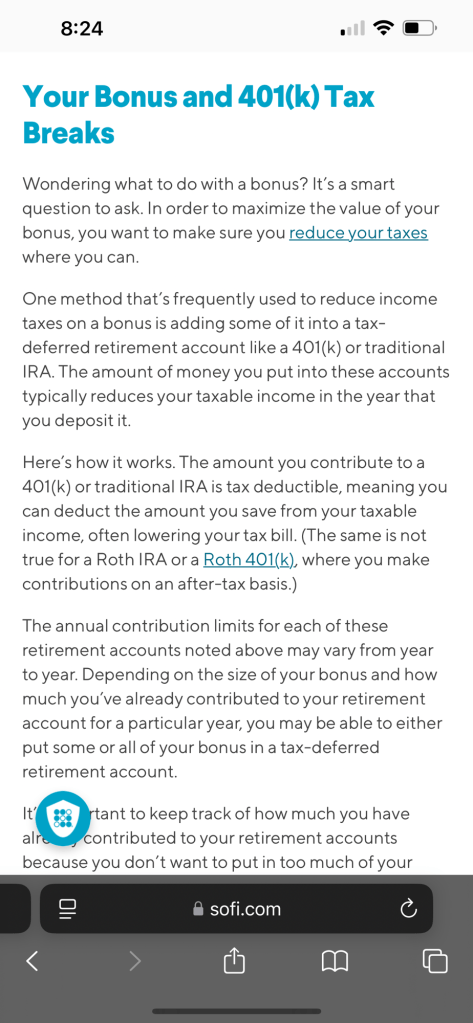
For starters, if you haven’t maxed out your 401k contributions for the year, you should have your employer contribute directly towards it and avoid that portion (or all if you’re below the limit) from being taxed at all. You can also defer your payment until after the New Year to avoid it being added to your annual taxable income, especially if your boss issued it on your payroll as part of your regular paycheck added together—that’s more taxes too. You can have part of it paid for the holidays and part of it afterwards to lower the tax implications and put the rest towards your 401k for next year or towards your Roth IRA, charitable contributions, etc. It’s also sometimes just better to have it put in your 401k and health savings accounts—more on that later. This is why it’s important to talk to a tax strategist AND have a separate CPA. They’re not often trained and educated the same, though they claim to be, and they get paid differently. Most CPAs also aren’t as savvy and working with you all year just on strategy do have both and make sure your CPA is getting the receipts to whatever your strategist has your money in.

Check with your 401k statements

Secondly, cash is so much more tempting to spend than putting it into your IRA, ETFs, HYSAs, or other investments. It’s just not easy for most people to fight the temptation to spend and blow it all. Have it direct deposited into your accounts that aren’t connected to your debit card!

Third, a boss giving an undocumented cash bonus and you taking it as such is tax evasion in both cases so don’t do it! Don’t accept without a W2 stub or reporting it to your accountant ASAP.

Also check your IRA accounts

Fourth, if you qualify for an HSA Health Savings Account, have your employer set one up right away and have the money put there. It’s never taxed!! It must be used properly but it’s way better than paying for regular insurance that is a waste of money, overpriced, and denies most of your expenses so you pay out of pocket anyway. Choose a HDHP high deductible health plan and then go this route.

Before you enroll!
How they work

Fifth, if you are issued a proper cash bonus, understand it is indeed taxed one way or another to be legal. It might already have tax withholding through your employer or you must declare it, especially if you have other filings besides a W2 form. Talk to a CPA and have them get everything straight so you’re not audited and in big trouble—or your company. Then, invest what you can or pay off debts and use it to your advantage. You can also make some end of the year donations to reap organizations to save on taxes as well but get receipts.

If you’re an employer, make sure you’re helping your employees avoid tax increases—and punishment by audits—and put their money in the right places!! It’s a tax advantage for you too so make sure you’re consulting with a strategist as well to ensure your CPA knows all the ways to save—even the best ones don’t know it all. Get a second opinion!