How I Found My Agent: a Short Story

Real Estate agents love to talk themselves up on their social media channels to promote their business; but between all of the “success” stories and posts of new listings and sold homes, you need to look further into it. First of all, those can be posts of solds from long ago, their office listings versus personal listings, or one they worked on partially. They also don’t mean they are a great agent or the best for you. Top agents have failed many clients who needed more than just fancy video tours and advertising posts. Clients sometimes need agents who understand what they’re going through and why they’re moving. They need an agent that understands your perspective as a much younger buyer who has kids in the school system, how important location is to you, or other factors that too many agents gloss over because they think they know what is best for you. I’ve had to fire agents when home shopping for myself because a much older agent tried to tell me what I shouldn’t buy. Our first home budget was low so many agents wouldn’t even help us because we weren’t worth their time. Others would say “there’s nothing in that price range” when we found dozens on Zillow. They’d say “oh, those are condos.” Yeah, so? I would ask if they don’t show those and they’d tell us, “you don’t want a condo, it’s just a smaller place. Wait and get a house.” We finally found a nice agent but all he wanted to show us were homes he thought were best for us and only a couple from our list. When we found a few we really liked, yes, they were fixers, but we knew with our budget and our preapproval, we’d get something outdated and not exactly pretty compared to the rest of the market. We didn’t care. We just needed a place and were done dealing with horrible landlords. The last two we saw had great potential but he was trying to talk us out of them. We had already done the preapproval with him and the lender he introduced us to, but it was clear our time with him was over. We switched agents.

She was sometimes rough around the edges but she showed us what we asked for and gave some great points. We did have one disagreement that rubbed her the wrong way and she said we were wasting her time. We said fine and quickly scooted out the door. She took off frustrated and we figured, maybe we need to wait a few weeks and try again with yet another agent and a better understanding of what we want to help our next agent understand us better. An hour later, she called me and I reluctantly answered. She was the peppiest I’d heard her be. Well, she had calmed down quickly and checked out the last two properties on our list on her own and apparently, one convinced her we should buy it. “It’s perfect! It’s absolutely perfect. I’m still here. Come meet me and see it!” We were shocked but five minutes away so we drove right over and she was right! It was a cosmetic fixer but easy stuff and we did have some savings to paint and replace all the floors after close so we put in an offer at list price–it was priced to sell. We got it. It ended up a long and stressful escrow with issues on the seller side and we had to switch from an FHA loan to a conventional loan, as well as lenders when the original lender from our preapproval kept making mistakes. Finally, we closed. She stuck with us and everything was smooth through all of it. No agent is perfect and no agent relationship is hiccup free but she got the job done and was on the ball. Her communication was awesome and besides that one issue, nothing else was a problem. She was a great agent for us and did the best job of finding what didn’t exist according to some agents and she didn’t treat us like the low end buyers we were. We were newlyweds with a baby on the way but we were treated as if we were any other buyer. She worked for her pay and it took months instead of weeks, but she stuck with us and remained diligent. That’s a good agent. That home was our home for 8 years and it was a fixer that we spent those years slowly remodeling. We sold for a huge profit and bought us our next home without PMI. It was the right choice for us at the time and the other agent didn’t see that. We did because we know us and we weren’t as young and dumb as he assumed.

A bad agent can be a good person but telling a client what they want instead of showing them all options and letting them decide, is not what you should be hiring to help you. It’s YOUR money and your life. Make the decision, not them. Giving guidance is not the same as giving opinions so make sure you’re getting the advice you need versus unsolicited advice. When you hire an agent, make sure they’re listening to your needs, helping you make decisions but not making them for you, and ensure they’re focused on what YOU want to buy instead of what they want you to buy. You have to live in this place every minute of your life so make sure it’s for you and a choice by you. Make sure the lenders they refer you too are also very good.

Agents and lenders should be kind, understanding, great at listening and responding, communicative, timely, professional, and meet deadlines regularly. If they’re not picking up, timelines aren’t being met, unorganized, lazy, rude, or not acting in a way you expect, then don’t use them. Before you put in loan applications, do a prequalification first, before preapproval, and pay attention how they prioritize you, how they answer questions, how they provide information, how they provide documentation, how they correspond with you, and how they act. If you’re not sold on them, don’t waste your time. If you’re willing to proceed, then come back for preapproval but keep paying attention to them. Their prepparoval should be timely, the communication excellent, and answering all questions with knowledge and detail that helps you. The actual application begins when you get an accepted offer usually so proceed if you’re ready. If you ever feel you picked the wrong lender, tell your agent. If you feel your agent isn’t right, tell their broker in charge. Every state has different rules and times when you can switch agents so be sure you’re ready to get into escrow with your agent and lender before putting in offers. It’s crucial to have the right people BEFORE buying the house. Remember that offers are purchase contracts. They are legally binding documents and legal commitments stating the people involved, that they’re the ones getting paid at close, and that you are committed to using all those people in the contract as your real estate professionals. Buying a house is a legal procedure that can have consequences. You can be sued, fined, or worse if you try to violate the terms of the deal. It’s a real CONTRACT that must be honored and treated seriously. Make sure you trust who is on those forms with your signature.

When to Marry the House and Date the Rate

You’ve heard this advice before but how legitimate is it and when is it best to do so?

The most important aspect to remember is that even the rate you’re wanting to “date” is something achievable and won’t create stress for you. Buyers have been approved for mortgages beyond their financial reach and it’s important to understand what you know about your finances. Your debts are included in your credit decision but not most of your expenses.

As lenders, we’re not looking at regular expenditures such as groceries and gas, or costs of kid sports and school needs. We aren’t digging deep into your pockets to understand how much you spend on Amazon and Target. We look at total credit card debt and total bank balances but we’re not here to nitpick how much you spend to live every month, dollar for dollar. That’s now how approvals work. For some, that can be bad.

Maybe when you apply, you’ve got a good savings tucked away to purchase and a decent income to verify. On paper, you’re a solid candidate but you spend paper that doesn’t get analyzed by the bank. Maybe your credit cards are paid down or you’ve got another account separate for shopping and miscellaneous so we don’t see that you have an expensive lifestyle—whether a spending problem or just a lot on your plate. For some, a mortgage doesn’t let them have those anymore or save for vacations, eating out, etc. That’s not when you date the rate.

When you date the rate is when even the high rates aren’t affecting your ability to live the life you enjoy and pay for the things you enjoy or want. If you are not seeing approval amounts for a monthly mortgage that’s reasonable, date a different rate—never settle.

You marry the house when the date went well and you have a rate you can live with. Look at dating the rate as dating a potential partner—look for red flags 🚩 and don’t let it make you give up what you’re not willing to sacrifice for.

The best way to getting into the “rate dating game” is to go for a pre approval with a qualified lender. To gauge your comfort level in the meantime, take your gross income before taxes and multiply it by .28 for Conventional and .36 for FHA. If you don’t like what you see, put more money away to put more down so you can get a better payment by putting more down. While you don’t need 20% these days, I always recommend at least 5% to lower your monthly mortgage payments on your loan m. 6-8% is even better if you can do it.

Mess around with online mortgage calculations, you can Google them, and plug in numbers you like. Remember to consider home insurance, taxes, and round up to the next hundred. Play with down payments too and see what might get you closer to your comfort zone. It might be rates are too high to get there or that you just need a little more saved to marry the house now and date the rate until refinancing next year if rates drop.

Marry the house when dating the rate is a comfortable price or wait a few months and shop the market again. Don’t commit if it’s not worth it to you. Don’t marry the house if you won’t even date the rate!!

The Worst Markets are the BEST for Buyers

The news makes the real estate market sound like a somber time but for buyers, this is THE time to buy a house. Why? Because when the market is this bad (one of the worst months in the last 30 years!) it means sellers are only selling because of a need right now. They might be relocating for work, financial reasons, divorce, other needs, and are having to sell in a difficult market knowing their home is going to sit for sale on average 3-4 months. It might even be creating a financail burden, as well as an additional stressor, so typically this creates a buyer’s market because these sellers need to sell soon. This means the market is ripe for buyers to have the upper hand and have all the leverage. Most sellers aren’t getting a lot of showings and open house guests nor offers so they’re stuck taking what they can get. Beggars can’t be choosers so if you’re interested in their home and you are the only offer they have received in weeks, you have the leverage to get yours accepted if it’s even remotely near their asking price. You also have the leverage to ask for seller credits to cover closing costs, or— rate buy downs. This is far more powerful than asking for $20k under list. A credit of the same amount, paid by the seller, nets them exactly the same BUT, it lowers your mortage payment far more than getting a discount on the total price.

Always remember: Your RATE is what makes your payment more expensive, not the sale price.

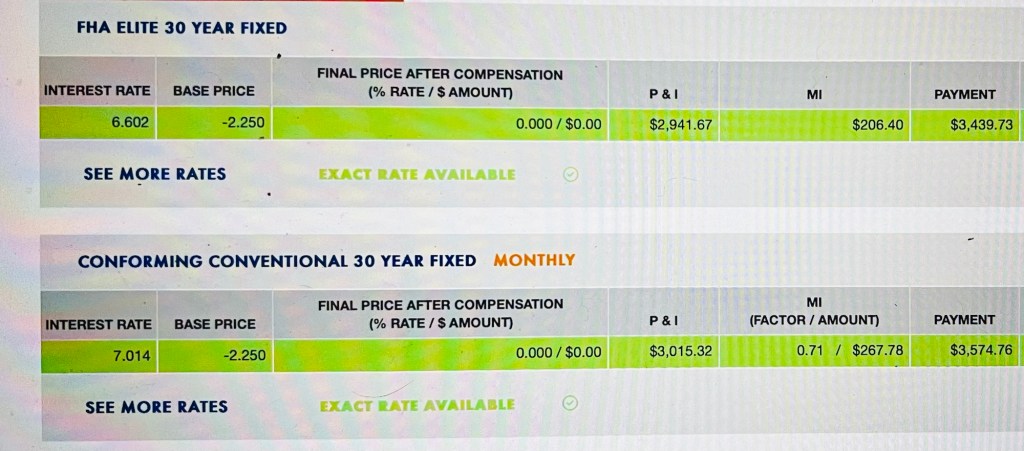
Allow me to demonstrate. Let’s say you purchase this house in Cathedral City, CA for twenty-five thousand under list price. Before taxes you and your spouse each gross about $4k every month or $48k per year before taxes. Your credit score averages to 715 and no other debts such as student loans, credit cards, or car payments. You have no HOA.

Listing from Capitis Real Estate

Your payment could look something like this with rates as of 10/8/2024:

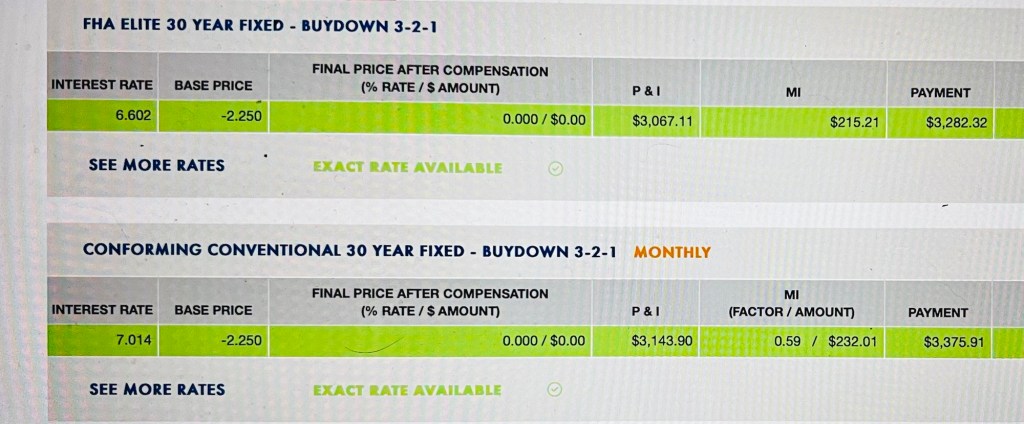
If you instead asked for the seller a credit to cover your rate buy down and get an approximate rate reduction based on a 3-2-1 buy down, here’s what you could pay every month while still paying list price and giving the seller essentially the same offer:

Mortgage estimates depending on credit, day, DTI, gross income, loan type, and other factors

See the difference? A good agent knows this and won’t suggest a price drop but instead a real way for you to save on your monthly payment. You do NOT need to wait for rates to drop to get a better APR, you just need the right agent and lender to get you there.

If you need a real estate agent who can help you negotiate the best deal and find you a home in your payment range anywhere in the country, email agentofparadise@gmail.com and I’ll send a you a referral depending on the area you need for buying and/or selling. If you need a lender in California, I can help with that too! Send me an email and we can set up a time to talk or get your application started. I look forward to helping you any way I can.

How to Get the Best Rates in this Market

Rates are down and they continue to trend that way as inflation cools and home sales are slow in many areas. This is the best buyer’s market we’ve seen in a few years and it’s also a treasure trove of savings if you have the right strategy.

Even with rates in the low 6’s, buyers in slow markets have an advantage of getting motivated sellers to work with them. Instead of asking for $15k-20k off the sales price, a buyer will actually save HUNDREDS more per month on their monthly mortgage payment by, instead, asking for that amount in seller credits to buy down their rate in a 2-1 buydown. The buyers will then get a rate in the LOW 4’s for the first year and a 1% reduction the next year because of it. Buy down points are expensive and can easily cost thousands so if a buyer instead asks for the reduction as a credit versus a sales price drop, they’ll actually save significantly more. Just offering $20k below ask doesn’t save you much, believe it or not, on your loan. It’s all in the interest rate how much you pay and how you’re approved of what you can afford. Don’t worry so much about the price but how much you will pay per month. Here are some examples how it makes a big difference:

We’re going to compare this listing in Yucca Valley, CA from C & S Real Estate with a price reduction and a buy down scenario to show you the real way to save money on buying your next house.

Listing Agent Sean Dittmer and currently for sale as of this posting

If the buyer offers $20k below ask, their mortgage would be looking like this:

This is based upon an accepted offer $20k below asking and about 3.5% down or $13,000

If they instead asked for that in seller credits to buy down their rate, their payment would be approximately this: See the difference?

This is asking price but 2-1 buydown rate. Discount points are where it’s at! The down payment only goes up to $14k as well.

This is the same buyer with a 690 credit score and $60,000 annual income.

See how offering well below ask doesn’t lower your payment as much as a buydown? You can also buy permanent discount points for that amount from the seller and buy down to that permanent rate of 5% that’s shown in the example. These are real calculations from UWM that we use to price a loan. Instead of offering $20,000 below asking price, get that amount to buydown your rate and pay lower than market. If your credit is better than this buyer, you can possibly end up paying a rate in the 4’s!

It’s important to note that the rate you’re approved for will go up a little on your Closing Disclosure (the CD) because it includes the APR which is your rate plus all your points and fees financed into the loan. The APR is your total cost of the loan percentage. Mortgage insurance (PMI or MIP) are included in that Annual Percentage Rate so that’s the final cost you will pay as a rate on your loan. The APR is that mortgage 💸 insurance, any fees and points, + interest rate for your total loan percentage (APR).

To get a total APR under 5% you need better credit. If you’re working on your credit still, make sure you reach out and work with me. It’s free and easy. If you’re ready to buy, THIS is how you get the best rate. Get those buy down points so you save money and the seller will net the same price. Win Win!

Let’s get started!

What is an FHA Streamline Refinance?

An FHA Streamline is a no-documentation refinance of an FHA loan. This means you don’t have to go through a credit-qualifying process, unless you have a borrower being removed and require regular underwriting, and you can more quickly close with less paperwork and still get the refinance benefits you expect. You do not need an appraisal or full credit pull. Your closing date needs to be at least 210 days ago and have six consecutive months of ontime payments and be at least six months since your first payment. These are FHA seasoning requirements so if your loan is newer, wait a little longer before applying to Streamline it.

Your FHA Streamline must have a net tangible benefit before proceeding with a refinance. The refinance should reduce your montly payment by at least 5%, reduce your term and/or rate, and provide financial benefit to the borrower in some way that is not more beneficial to the lender than the borrower.

That’s it! It’s just a modern way to refinance your home on an FHA loan to get a better rate and save money on your monthly mortgage payment. You don’t need to go through the employment and income verification process the same again as you did at purchase. Underwriting of the Streamline refinance will go through all of the back end things on their own and much of what you need is verifiable without submitting new documentation all over again. It’s a much easier and faster closing process, which is often all virtual now, with less stress and more of a, you guessed it, streamlined procedure start to finish.

Reminder: This is for FHA loans, not Conventional. They’re done differently just as they are for purchases. This also doesn’t apply to USDA loans and VA have their own process to refinance.

A First Time HomeBuyer Isn’t Actually

Most people assume they’re not a first time home buyer because they have owned a home before but that’s not how the mortgage definition actually works. Let’s say you have owned before but have been renting the last few years, then you probably qualify. The clock resets every 3 years. If you have not had your name legally attached to an OWNED property for at least three years, then you qualify as a first time homebuyer to take advantage of low down 3.5% FHA (which are actually NOT for first time homebuyers but anyone!) and 3% down CONVENTIONAL loans which are specifically for buyers who haven’t had their name on any title or loan in three years. Otherwise, you qualify for an FHA or 5% down conventional which is for everyone buying a primary residence regardless of previous ownership.

If you’ve co-signed or were on a home that sold in less than three years from the time you wish to apply for a new loan, then you do not qualify. Your name must have been on no loan or title in the last three years to qualify. If it’s more than three years, you do. First time home buyer loans are primarily low down programs to help people get into their first home or first home in a while so that’s why it applies to more than just those who are brand new to buying real estate but also to those trying to own again. Many people can use these after the first 12 months to then use as income properties or so long as they live in at least 6 months of the year after on FHA and certain grants, they’re fine. It’s mortgage fraud to not follow the terms of your loan and using the property as any type of rental so know your loan conditions! They have different terms so you need to consult with your mortgage originator and go over the terms if you’re hoping to one day rent out the property or turn into another type of income-generating endeavor soon after close.

If you haven’t been on a loan or title in three years, then absolutely look into a 3% conventional FIRST. FHA not only charges an UPFRONT MIP, it’s for the life of the loan usually. You can remove PMI for conventional loans but most people confuse it with MIP on FHA loans which is NOT the same thing and almost always permanent. There are some conditions if you put a lot down but that’s rare. Conventional loans offer greater relief from costs and paying fees so check them first. You want more of your money going towards principle than fees and interest!! If your credit and DTI aren’t great, you DO NOT have to be a first time homebuyer to get an FHA mortgage. That is a longstanding myth and again, confused with the low down conventional program of 3% and removable PMI (NOT for FHA which uses MIP). You can use FHA as often as you need so long as it’s your primary residence and you’re not clearly selling every few months and flipping those properties. If you owned your home over 90 days and then sold, you can still use one as long as no mortgage fraud is happening and all parameters of FHA were followed. Again, consult with your MLO to ensure you’re following the rules of your mortgage terms.

There are FHA programs however that allow you to buy and flip, like HomeStyle loans and such but those are specific programs and not the standard FHA or Conventional loan 95% of buyers use that you’re likely going to be using as well. If you’re looking for those programs, make sure you’re honest and upfront with your lender to make sure you get the right program as those loans also help fund renovation costs and help keep contractors on point. Don’t commit mortgage fraud to try and get a better deal! Just get the right loan and you should get the best deal anyway because many loans are available to investors that are not all requiring 20%. If you do have a big down though for any type of loan you will absolutely save on the mortgage insurance costs lenders charge but it’s not necessary for many loans. Ask your mortgage person!

For more information email jenniferlarsonent@yahoo.com and please put LOAN in the subject line so it doesn’t get missed. Thanks!

What to Do With Major Debts

A lot of people have recently brought up the mention of dealing with major debt like foreclosure and bankruptcy and how it affects their finances and loan chances. To be honest, I have held back on talking about this because I am not a bankruptcy lawyer and there are so many situations to consider. There are also different types of bankruptcy and they each impact your credit, future, and current debts differently. There are so many scenarios where they’re appropriate and so many life situations that need to be considered with a qualified attorney to go over your options. I can tell you the amount of debt is not indicative of necessity. One thing people need to realize too is the impact of foreclosure vs bankruptcy, and the difference between letting your credit take a hit instead of the next several years’ impact of bankruptcy; because it can prevent you from having a future for the next decade, including trying to rent and get a job in some cases. Bankruptcy is intense and a major last resort decision only you and a qualified expert team should be making.

Bankruptcy is not to avoid paying debts!!! It’s not to just avoid someone coming after you. It’s a massive deal and it can have drastic consequences that will impact your future financial situation as well. Always consult with a professional beforehand and go over your finances with them as well as your creditors individually before coming to that final call. Bankruptcy doesn’t help you escape debt and it’s not without risks so make sure you find a good one with great reviews and who listens to you. You’re usually going to have to pay out something to those creditors and attorneys too. It’s not an easy thing and scapegoat for debt.

Clients who come to me about bankruptcy are typically asking because they either want to buy a house but are afraid they never will with the mountain of debts and/or the current risk of foreclosure they already have, or are going to be experiencing. Sometimes they’re trying to get out of a house they can no longer afford and are worried they’ll lose it, or will, and don’t know the impacts filing bankruptcy will have in getting out of that house and into a place they can afford. Other times, they’re in the process already, or just finished, and want to buy again. There are massive credit impacts and rules in the following years after a bankruptcy filing. Most people don’t understand the impact, unfortunately.

Before you go that far, work your butt off to get those debts lowered as much as possible. Call your creditor to negotiate down fees, interest rate, balance due, back payment, etc. Whether you need to give them your sob story or literally sob 😭 on the phone, do what you have to do to cut your debts and payments down as far as possible. Next, be honest. Can you afford to keep the cars and house? Whether it’s a need is irrelevant if you can’t afford to keep it. Figure it out. Tens of millions of people move closer to work or find ways to get transportation. Make it happen. Don’t be ashamed or “too proud” to take the bus, get a “lesser” car, etc. Do what you MUST to survive and eliminate payments you can’t make anymore.

If you’re worried your creditors or bankruptcy will make you give up your home, do your best to sell first, especially if you have equity. That equity is CASH that can pay debts and keep creditors away. Maybe it will help you keep a car or two, pay down other things, etc. You should always focus first on paying down, or off, each individual debt on its own. Cars and houses can be sold, refinanced, paid down faster, etc. compared to many debts. Student loans are very hard for most people to pay down much earlier but depending on credit card debts and personal loans, those can sometimes be renegotiated and then paid down or reduced. If you are really strapped, I would focus on paying your essentials first. Can you at least afford your car and house? If not, you need to make a decision. If you own your home, maybe you need to sell, refinance, get a roommate, rent it out and move into a cheaper place, or out of state. If you can have the mortgage assumed then great, etc. but you need to make painful decisions before you lose everything and it affects your future. A home with equity can be sold to eliminate that loan but also pay the car down or off at least; and that eliminates two debts. It can be used to pay off or pay down credit cards or other loans that are of biggest impact to your debt problems. If you’re renting, you need to choose your most important bills to keep. Is it rent or the car? Can you downsize to save temporarily while paying off some debts? Make difficult decisions and accept the reality before it bites you harder. Too many people struggle with making hard choices so they make none or the wrong ones. You can’t afford to do what you want to do. That ship has sailed so do what you NEED and SHOULD do and get it done. You’ll get back on your feet but right now, eliminate debts one by one, or at least dramatically reduce them any way you can. It’s better to let some things go to collections than lose everything. Bankruptcy is not usually the answer and shouldn’t be your first choice but for some, it is the answer. Again, consult an attorney but a good attorney will usually also recommend you try to avoid bankruptcy proceedings if at all possible. Do your research!!

In regards to applying for a loan or how these debts might affect you, they will almost always limit your loan options and amounts. Get your debts somehow paid off, preferrably, versus just losing everything. If you can’t sell a car for the total loan balance or you can’t sell it all, losing it to repossession is probably better than filing bankruptcy and you usually have months before they actually come and get the car so you can maybe buy some time and come up with the money–especially if you’re selling a home and will earn some money from the sale to pay it. Unless your credit cards are astronomical, same thing applies. If you’re in debt though tens of thousands of dollars on multiple loans with various creditors, then maybe bankruptcy is best. I don’t know how people let the debt creep up like that but they do it constantly and ruin their whole life! If you’re in massive debt beyond words, yeah, you need an attorney. If you’re not there yet, do not use debt to get out of debt!!! So many people do this and it makes no sense. It’s literal insanity. STOP!! You’re going to make everything so much worse. Swallow your pride (you shouldn’t have any at this point, honestly) and do what’s best for your family. There are services to help you when you can’t pay your mortgage, can’t provide for food, etc. Being “prideful” is not something to be proud of and what pride do you have? Not paying the bills? There’s NOTHING wrong with asking for help and keeping food on the table if you need services for a little while. Kids don’t care as long as they’re fed and basic needs met. You should feel the same. Get financial services like WIC or EBT and feed your kids!! You’re paying into it in case you ever hit hard times. It will help you as you salvage your situation and no one goes hungry. There’s no pride in bankruptcy and losing everything. NONE.

This country has a massive problem with understanding simple finances and debts. The government didn’t make your decisions, you did. Hourly jobs aren’t enough and haven’t been really ever. I’ve always had to have two full-time jobs and a side job. ALWAYS. And even during those times, I had roommates in a one-bedroom apartment. I made things work to pay off debts and I have lost things to financial ruin during that time. It’s tough but you get through it and come back better than ever if you’re smart. Don’t be prideful, be strategic and you will WIN in the end.

Which Debts Are Most Important to Pay Down?

For a home loan, it’s not medical debt. In fact, the Biden Administration is focusing on passing legislation through Congress that would eliminate it from being considered in your credit score for many types of financing and home loans. It also depends on what your credit report says (go to http://www.annualcreditreport.com) and a detailed report will show this if lenders can see it or not but it’s not typically a factor to worry about for approval. The biggest hindrance might be your student loans.

Make sure you’re getting as much loan forgiveness as you can and negotiating with your creditors to reduce fees and interest rates. This will help lower your payments and DTI which helps you get approved for more. If you don’t have student loans, your next biggest hurdle is probably your car.

Cars of all brands are absolutely ridiculous nowadays. We have clients paying almost a thousand dollars for Fords and Toyotas and I’m not talking their top of the line models with extra features. It’s insane right now so imagine for luxury cars how that can affect your approval! Add up your car payments and that amount will be how much less you’re approved for in underwriting because that’s all DTI and those numbers are subtracted from your total approval. We start with your front end DTI which is just how much the house will cost you per month to buy. Your back end DTI then starts reducing that amount because we have to factor in your cars, your credit cards, payment plans you’re on, etc. If it’s on http://www.annualcreditreport.com and you pay monthly on it, it’s probably going to reduce your approval amount. Car payments by far are the biggest killers of dreams and buying a house. Don’t buy brand new, and get them two years old at least, to save thousands on dealer mark ups and depreciation.

Next is credit cards 💳. People use these like free money and they’re NOT! Before you apply for a mortgage, make sure you are below 15% utilization and don’t be surprised you have to pay below 10% to get approved. Clients need to understand their current balances due are a major factor because it’s debt we have to account for. Pay it down tremendously before applying. It doesn’t matter if you always pay in full, pay before you apply!!

These are the top debts to pay down (or off if you can) so that your chance of a new house isn’t ruined by all these payments. You can have debt and buy a house but you can’t have a lot of debt. Lenders want to see fiscally responsible borrowers and big car payments and credit card balances are not a good candidate for rates around 7%. Sorry. 🤷‍♀️

Three Places to Put Your Money in Now

Check your bank statements or call your bank and ask but if your money is in Bank of America, Chase Bank, Wells Fargo, or even most credit unions, you’re earning a couple of pennies in interest instead of dollars every month. Standard banks don’t pay in interest like online banks because they’re more obsolete. They maintain thousands of branches that have building costs, bills, excessive expenses, and most people don’t even go into the bank anymore. There are ATMs everywhere these days and you can transfer money in a click or deposit at ATMs or other cash locations. Online banks offer these too in person at ATMs and authorized locations and they also put way more into services and products for their customers so they get better returns like an HYSA and investment tools.

  1. High Yield Savings Accounts are savings accounts with online banks that pay WAY MORE than standard banks in interest and many have no or less fees compared to the standard branches most Americans use. I use SoFi, Marcus by Goldman Sachs, and Captial One because their services and apps are awesome and I can build wealth so easily through them with rarely a cost. I have a free account bonus through SoFi as well that I’ll link below. APRs go up and down with the Fed Rate but they never crash down to the slap-in-the-face rates your regular bank is paying. Currently they’re almost 5% in HYSAs while most other banks never pay you more than .02% no matter the economy or rates. That’s almost as good as your mattress or piggy bank. You can do better and it doesn’t cost you anything to switch or move your direct deposit. In fact, they might pay YOU to do it in those online banks. There are dozens of banks that can do this but you know my favorites by now.

2. The second place is a Roth IRA if you don’t have one. Mine is also now with SoFi and it’s linked to my bank accounts for automatic deposits but on the SoFi app I can also manage it instantly and add more money in seconds or change the investments within the Roth. Remember that your money in a Roth IRA is put towards investments so it can grow your tax free retirement while you sleep for years to come. I invest mine in ETFs that have so little risk like VOO, SPY, VTI, VUG, QQQ, and others. Those all constain top stocks like Amazon, Google, Disney, Microsoft, Meta, Tesla, and others. Since the money you put in here is through your bank and paycheck it’s a post tax contribution. You’ve already been taxed on this money and now you’ve gotten paid so you’re putting it into your Roth IRA so it doesn’t get taxed again when you pull it out when you’re 70-or anytime after 59 1/2 without penalty or other fees and taxes. It’s a tax free retirement this way so you aren’t taxed on this money again in your golden years like some retirement funds. Remember that Roth IRAs contain investments like stocks and ETFs that you invest your funds in, within the account. You can buy shares through many investment sources.

You can also buy those in fractional shares of any amount you want on platforms like ETrade and SoFi. I use both apps and in my SoFi I have automatic deposits into my individual brokerage account that I can then use to buy whatever portions of stocks I want. I can buy whatever I like in any of those but also ETFs as mentioned above in small increments because it adds up to real stock value over time and you still get paid dividends on those fractional shares which can be free money to keep investing. That’s what I do! I don’t pay fees or anything either and it literally takes a few seconds to do. Since I’m putting my money in a Roth IRA, it’s not getting taxed anymore and I won’t in my older years. It’s not income yet but it’s earning income from what I deposit AND it’s going to work when I do too so the money never stops growing.

3. The third and final place are ETFs because they’re average return year over year is 10-12% for ETFs that track the S & P 500, like those I mentioned above. They’re by far the most popular because of the stocks they contain, the success they’ve had for decades now, and how little they cost to acquire. Get yourself started with a VOO ETF which is by Vanguard, a very well known and respected finance company, and put it into your Roth IRA right away, whethere it’s a whole or fractional share. Get started with any amount you can and grow it by any amount whenever you can. Then get SPY, VTI, VUG, and QQQ. There are many others but start with these at least. They’re far smarter than trying to play the individual stock game and don’t come with the crazy risks of buying stocks and daytrading in what you don’t fully understand. You’ll make money doing nothing and it just builds for years or decades as you go on with your life. Any income can do this. I do it in my SoFi app and every payday. I started with $15 per check and I worked my way up 10 times that weekly ($150 per week) and it just keeps growing. I made dividends off some ETFs when I only owned maybe a third of a share and that money was put right back into the shares to buy me more, for free! I never lose money and these are long term stocks so a bad month or year won’t affect me at all.

These are just a starting point but if you want a successful financial future and you don’t have the education or career path where you’re going to be making good money anytime soon, you’re going to need to do this. If you read my other blogs, I have so many ways to help anyone at any income tuck money away and make a successful retirement and future without bills and with little money. Whether you have ten bucks or a thousand, I can help! Check out other articles or email jenniferlarsonent@yahoo.com and put SAVINGS in the subject line so I see it and respond. All of my services are free and I have free referral links for money credits if you open a SoFi account as well. I use them more than ETrade now because ETFs especially are not always traded on ETrade and while they allow fractional shares, SoFi allows them on every ETF I’ve bought so far and it’s automatically deposited every paycheck so my accounts are all automated and earning money the second I get paid!

Roth IRAs do have a few rules like annual limits to how much you can deposit. For 2024, the limit is $7,000 a month for anyone under 59 1/2 and there are some income limits (in the six figures) every year for couples or single folks so make sure you know those for the current year. If you do make a higher income, ask your financial advisor about a Back Door Roth IRA strategy and also put money in your IRA towards all the ETFs we mentioned. You can also have a traditional IRA and 401k accounts too. I’m not as well-versed in accounts for those making much higher incomes and at the age of 60 because there are so many other variables at that age for retirement accounts. The investment strategies are very similiar but not everything so I recommend a financial advisor through Fidelity, Vanguard, Charles Schwab, Morgan Stanley, Edward Jones, and others. I have accounts with all of these companies and I get so much help just calling my assigned advisor and working with them. Most only get paid through returns and programs so I don’t pay anything just for advice.

For anyone under 60, it’s a more basic approach and also focusing on the long game while you’re not a legal retirement age to cash out these accounts. Keep up with watching your money and remember that quiet wealth is real wealth. Don’t focus on “keeping up” with the Jones’ or what everyone is buying on IG. Stanley Cups are stupid and just cups. They leak and they’re nothing innovative.Most influencers got them for free or make money to promote them and the same goes for all of that Studio McGee crap and any other brand. If they’re sharing it, they have an affiliate link and probably a promotional contract with the company otherwise they don’t even tell you about what they’re buying. Many of them get paid too or return the stuff a couple weeks later. The rest are just in massive credit card debt and have no savings. Don’t buy into this ploy. Unfollow people that make you want to buy stuff and put that money to better use. I have recent articles on this subject too and how I got myself out of this bad trap. Check out any of my blog posts before this one and there’s some great information to get out of debt, into a little bit of money, and stop this cycle of feeling less than. Don’t play the game, beat the game.

Here’s my SoFi link 🔗 to get a free sign up bonus!

Hi! 👋 Join me to start earning more money with SoFi Checking and Savings. You’ll earn up to 4.60% APY and pay no account fees. Use my link to sign up and you’ll get a $25 bonus and up to $300 when you set up direct deposit. https://www.sofi.com/invite/money?gcp=ae5e4b53-7a4a-4c2e-b9c4-de9b1f78b843&isAliasGcp=false

Grab a Comb!

This is how I got financially stable.

When you think about going through your finances with a fine-toothed comb, what emotions do you feel initially? What are your automatic reactions to analyzing your financial statements? When going through your credit card charges, your debit card swipes, and your bank activity, fear and anxiety should not be what you go through. Assessing your monthly statements and weekly expenditures should be empowering and thought-provoking. There shouldn’t be a negative and angry feeling when being told to heavily dig through your expenditures. For too many people though, it’s a source of agony and becoming defensive even. I get it. I used to go through my bills and be overwhelmed and stressed until I changed my attitude about being broke and getting the electricity turned off–multiple times.

Now, I go through my almost daily purchases and expenses and I grill myself about every one of them. Did I really need a $10 sugar-crap coffee drink to get through my day or did I just want it really bad? Could I have gotten my caffeine from the $2 Americano and been functional without the calories and money wasted? Absolutely. Many times I could have not stayed up scrolling or letting my mind wander with nonsense. I could have drank more water during the day and ate better to be more energized. I had at least $8 here and there that were wasteful and they could have kept the lights on, kept my account from overdrafting, and maybe even given me $50 for the month to put into a Roth IRA with VOO and grown my net worth instead of drinking junk and throwing the cash away on frivolous stuff. This was the horrible place of spending money I was caught in. This is the rat race I let myself run.

I had a self-depricating mindset of other people were doing it and it looked fun, like what I thought living life should be at the time. I “deserved” to “treat myself” and I wasn’t living if I couldn’t even go to the store and get myself a coffee or whatever cute thing Target was releasing. I realized my own behaviors though and also started thinking, do billionaires think of stuff like this or is it just people who are living one paycheck at a time? The average person, who is more broke than me, thinks this way. That’s when I realized that mindset was the reason I was broke and cute stuff and expensive drinks weren’t living or treating myself right. They were hindrances to a bigger account balance and traveling or buying a house, getting a better car, etc. “It’s just $20” eating out, impulse purchases, coffees, being influenced on IG, Stanley’s, etc–it’s all destorying the country and their ability to afford the basics. Most Americans are trying to keep up with the Benjamin’s instead of saving them and putting them into HYSAs, IRAs, ETFs, and putting it away for far better treats–like travel and bigger purchases, even education or upgrading their home. This type of thinking alone can make you broke and destroy every dream you have. It sounds dramatic but it’s factual when you think about the big things you can’t afford, like a home or a better home, replacing the car, getting a car, going on trips, doing more things with the kids, buying clothes, improving your home, getting an education, having savings or an emergency fund, whatever. If you’re living paycheck to paycheck but also having this mindset of “deserving” and “treat y’self” then you need to realize how detrimental to your future this could be now and when you’re old and can’t work.

Write a list of all things you’d love to do, the places you would love to visit, the life you want, and the dream life you wish you could have. Do you want to die with barely any of that list checked out? Do you want to die with one or none of them ever happening? That’s the trade off for “treats” and a “deserve” mentality. I had it too but I wasn’t as bad as most Americans which was the saddest part of what I was realizing about our American culture. I was still watching savings, trying to put any small amount way, studying business and finance, but I wasn’t as good at practicing it as I wanted to be. I started shopping the cute things by putting them in my cart and wandering the store for fun. As the minutes passed, I would look down at my cart a few times and the thrill of the buy was already wearing off. I would put a couple of things back. I’d think about where I would put it and would I love it as much a year later? Or would I want the next nice thing and get it too? I was going to be in a bad cycle of buying and selling on Marketplace or donating if I was honest with myself. I started developing a better habit of putting the stuff away and walking out of the store with less and less. I was learning to walk out of Target without the new products I loved and without “fun” spending I was allowing to happen.

I got honest and focused on what I was doing and how I was swiping my card every day. Before I got to the register, I went through its cost and value to me, my future, my kids, and if it was the new thing I wanted now or was it something I’d be so happy with and still conscience of a year later. Decor and pretty things lose luster when the next pretty thing comes out. I was not going to fall into that trap. If the item I wanted to buy fit into that cycle, it wasn’t best for my kids and our futures so I didn’t buy it. I was saving money by being smart and not comparing myself to anyone else. I had a mission to not spend what I did not need. I no longer felt “this is not a way to live” and started feeling like, “this is going to be a better way to live”. And it was. Those small “reward” purchases add up so much faster than we admit and they added up to a flight to Europe for my family in two years! It was a great feeling to look at material goods and eating out as not treats when they weren’t as fulfilling as what putting that money elsewhere would feel like. Coffee in Paris or coffee in Target? Joanna Gaines on my dining room table or eating at a table in London? That’s how I see money now and how I put those amounts into a high yield savings account every time I was tempted to spend them elsewhere. That’s how I got the trip paid for!

I stopped getting to payday with an empty account and I was getting back to the person I was who didn’t care about new stuff and what everyone else was doing. I was happier with more money and less stress. The stuff I was buying wasn’t making me nearly as happy as the account having some wiggle room and there being left overs between paydays. I was starting to have $50-100 per month to put into ETFs like VOO through my Roth IRA and I was building great wealth off very little a month. I was going back to what I was always taught and believed in but hadn’t practiced lately. I noticed when I was falling behind financially I was making myself more behind trying to cling on to better days by “spoiling myself” with Starbucks and going out to eat because I was masking how horrible I was really feeling about money and wanting to pretend for a bit I wasn’t so broke when I very much was. We use things to make ourselves feel better and in reality, we feel worse, because deep down we know this behavior is self-sabatoging when the electric bill comes in or when you might not have enough gas to make it through the week. When I was doing okay, not great, but not as bad, I noticed I wasn’t feeling as bad about myself and how I was in comparison to everyone around me. I wasn’t spending as much in places I shouldn’t and I wasn’t feeling bad about “missing out” not going to eat out every week or consciously deciding not to go to the coffeeshop because it was a waste of money. I noticed, I didn’t miss those things as much when I could kind of afford them or afford them once a week because it no longer felt like I needed to treat myself. That’s when I learned too why we act like this. We sort of self-medicate with stuff trying to feel better about not being able to afford the stuff. It’s a vicious cycle and it does hurt the long term more than the here and now. It was living a lie and hiding behind the truth. It’s awful.

I started following the rule of, instead of buying the stuff to feel better like I’m doing better than I am, like I was trying to impress people and myself, I started started living by the rule don’t buy their stuff; invest in their stuff. I started seeing reminders everywhere to not spend $10 in Starbucks but $10 ON Starbucks. I started using ETrade (which is free) and I started buying fractional shares of Starbucks, Apple, Amazon, ExxonMobil, etc and then I realized as the markets were doing well, how powerful ten bucks could truly be. I stopped spending and started buying shares in tiny increments. Wow, does it add up quickly. I had multiple shares in all of them and I kept going.

I changed my mindset and fears around scrutinizing every little penny I spent. I no longer felt ashamed and humiliated how I was so broke that I had to nit pick every small purchase this deeply. I no longer felt it as a bad thing but a power shift and life step in the right direction. If I cut $50 a month in dumb spending here and there and put it OUT of my checking and into a savings that wasn’t connected to my current account, I was building a small bit of cushion which was more fulfilling than any item, trend, drink, status symbol, etc. I wasn’t as broke as I thought but I was more wasteful and stupid than I had thought. Going through every dollar I spent wasn’t ridiculous or pointless because it showed me how much I was letting go without much benefit and it showed me how much I had left over when I stepped being wasteful. Going through my finances with a fine toothed comb showed me I had potential and a little bit, not much, but a small amount that I could get out of being paycheck to paycheck and squeeze enough every month to have a padding and I slowly got more efficient on my bills too. I started getting better at not even going places that tempted me to buy and I stopped being tempted by them to go in. I don’t even go inside Target anymore and I save even more now because I only search what’s on my grocery list instead of going through the store.

The grocery aisles can be sneaky on your budget too and make you spend more even if you no longer explore the new Magnolia or Studio McGee products. I noticed I was getting caught up in sales or whatever looked too good (NEVER shop hungry or full!) and so when I started only shopping on the app with exactly what was on my list then checking out, I was savings HUNDREDS every month! I was saving hundreds and had a couple hundred every month now for my Roth IRA where I was learning how simple ETF purchases could make me rich in retirement with only $100-200 per month and eventually more. I had less debt and more to pay off what I did owe. I was slowly becoming even more smart with money with cash in the bank despite my income not changing. It was crazy! I have no debt now and I buy smart. I buy only what I need at Target through drive up and I don’t guilt buy anything for the kids either or get sucked into sales of stuff that’s cool but not a need.

I was becoming more and more encouraged about finances and putting money in better places than my bank account which wasn’t growing with interest like I expected. I thought about everything my grandma taught me about stocks and savings and I started learning more. I read books, listened to podcasts, read articles, and went to webinars to learn as much as I could. I watched business shows, and only followed business and finance accounts. No more scrolling, binge watching, or wasting time posting. I was learning and realizing this is how billionaires work too. Celebrities and show offs on social media flash their wealth but truly wealthy people are simple, monitor all expenses no matter how small, and live a more quiet wealth lifestyle. It’s not for show. It’s for comfort and peace of mind. That was the goal I set from then on. I stopped consuming consumerism content online or people who posted their Amazon hauls, outfits, stuff, decor, whatever and never bought into it or the idea of needing a lifestyle of a certain kind because it looked good. It didn’t mean it was BEST for me to live that way because it was a shiny object way of life. It all comes and goes and so does that money so it was no longer for me. I wanted the money coming and growing so I followed new money rules. If I saw something and was tempted to buy a want, not a need, and it was Target, Amazon, etc. I instead, put the cost into their stock or my Roth and let that money be put to better use. This is where I saw my accounts all growing in the right direction. I care less about stuff and more about the next decade and where I’ll be financially then. Not how pretty my house is compared to Instagram or what cup everyone is carrying. I can put $50 in way better places that pay me thousands back in retirement than a cup because the internet got obsessed for some reason.

This is the power of simply changing your mindset and small habits because these little actions, like interest, compound over time and continue to slowly grow into big returns. Read the Slight Edge and Compound Effect, the 12 Week Year, and other books. They help so much!