Rates are down and they continue to trend that way as inflation cools and home sales are slow in many areas. This is the best buyer’s market we’ve seen in a few years and it’s also a treasure trove of savings if you have the right strategy.
Even with rates in the low 6’s, buyers in slow markets have an advantage of getting motivated sellers to work with them. Instead of asking for $15k-20k off the sales price, a buyer will actually save HUNDREDS more per month on their monthly mortgage payment by, instead, asking for that amount in seller credits to buy down their rate in a 2-1 buydown. The buyers will then get a rate in the LOW 4’s for the first year and a 1% reduction the next year because of it. Buy down points are expensive and can easily cost thousands so if a buyer instead asks for the reduction as a credit versus a sales price drop, they’ll actually save significantly more. Just offering $20k below ask doesn’t save you much, believe it or not, on your loan. It’s all in the interest rate how much you pay and how you’re approved of what you can afford. Don’t worry so much about the price but how much you will pay per month. Here are some examples how it makes a big difference:
We’re going to compare this listing in Yucca Valley, CA from C & S Real Estate with a price reduction and a buy down scenario to show you the real way to save money on buying your next house.
Listing Agent Sean Dittmer and currently for sale as of this posting
If the buyer offers $20k below ask, their mortgage would be looking like this:
This is based upon an accepted offer $20k below asking and about 3.5% down or $13,000
If they instead asked for that in seller credits to buy down their rate, their payment would be approximately this: See the difference?
This is asking price but 2-1 buydown rate. Discount points are where it’s at! The down payment only goes up to $14k as well.
This is the same buyer with a 690 credit score and $60,000 annual income.
See how offering well below ask doesn’t lower your payment as much as a buydown? You can also buy permanent discount points for that amount from the seller and buy down to that permanent rate of 5% that’s shown in the example. These are real calculations from UWM that we use to price a loan. Instead of offering $20,000 below asking price, get that amount to buydown your rate and pay lower than market. If your credit is better than this buyer, you can possibly end up paying a rate in the 4’s!
It’s important to note that the rate you’re approved for will go up a little on your Closing Disclosure (the CD) because it includes the APR which is your rate plus all your points and fees financed into the loan. The APR is your total cost of the loan percentage. Mortgage insurance (PMI or MIP) are included in that Annual Percentage Rate so that’s the final cost you will pay as a rate on your loan. The APR is that mortgage 💸 insurance, any fees and points, + interest rate for your total loan percentage (APR).
To get a total APR under 5% you need better credit. If you’re working on your credit still, make sure you reach out and work with me. It’s free and easy. If you’re ready to buy, THIS is how you get the best rate. Get those buy down points so you save money and the seller will net the same price. Win Win!
For a home loan, it’s not medical debt. In fact, the Biden Administration is focusing on passing legislation through Congress that would eliminate it from being considered in your credit score for many types of financing and home loans. It also depends on what your credit report says (go to http://www.annualcreditreport.com) and a detailed report will show this if lenders can see it or not but it’s not typically a factor to worry about for approval. The biggest hindrance might be your student loans.
Make sure you’re getting as much loan forgiveness as you can and negotiating with your creditors to reduce fees and interest rates. This will help lower your payments and DTI which helps you get approved for more. If you don’t have student loans, your next biggest hurdle is probably your car.
Cars of all brands are absolutely ridiculous nowadays. We have clients paying almost a thousand dollars for Fords and Toyotas and I’m not talking their top of the line models with extra features. It’s insane right now so imagine for luxury cars how that can affect your approval! Add up your car payments and that amount will be how much less you’re approved for in underwriting because that’s all DTI and those numbers are subtracted from your total approval. We start with your front end DTI which is just how much the house will cost you per month to buy. Your back end DTI then starts reducing that amount because we have to factor in your cars, your credit cards, payment plans you’re on, etc. If it’s on http://www.annualcreditreport.com and you pay monthly on it, it’s probably going to reduce your approval amount. Car payments by far are the biggest killers of dreams and buying a house. Don’t buy brand new, and get them two years old at least, to save thousands on dealer mark ups and depreciation.
Next is credit cards 💳. People use these like free money and they’re NOT! Before you apply for a mortgage, make sure you are below 15% utilization and don’t be surprised you have to pay below 10% to get approved. Clients need to understand their current balances due are a major factor because it’s debt we have to account for. Pay it down tremendously before applying. It doesn’t matter if you always pay in full, pay before you apply!!
These are the top debts to pay down (or off if you can) so that your chance of a new house isn’t ruined by all these payments. You can have debt and buy a house but you can’t have a lot of debt. Lenders want to see fiscally responsible borrowers and big car payments and credit card balances are not a good candidate for rates around 7%. Sorry. 🤷♀️
The first thing you should do is go to www.annualcreditreport.com and pull your report to make sure there are no open accounts you don’t recognize and make sure any older accounts (besides bankruptcies and evictions) are off. Most should be removed after 7 years. Most medical debt is not your big focus but old credit cards you defaulted on, loans etc, and foreclosures that are 7-10 (depending if they’re part of a bankruptcy filing) should also be gone too if they’re over 7 years. You report needs to be cleared to really start building credit or you’re going to need to look at your newest debts and start paying them down. If you’re deep in debt, those need to be cleared before you take action and begin building a new credit future. If you had something repossessed and still owe on that balance, especially if they’re a newer debt (5 years or less) they’re going to be keeping your future from happening. Own up to the past and take care of it. We all make mistakes, hit rock buttom, and we all have to dig out of a huge hole. Just do it and pay your obligations. You incurred the debt so just make it right not for the company but for YOU. Your future deserves a fresh start but it can’t happen if you don’t remove all the junk you want to leave behind.
You need a clean slate, or at least have no negative hits anymore that are on there, and start from scratch. From personal experience and many others I have seen start over, Capital One and Discover are the best and easiest cards to get with no credit. You need a stable income of minimum wage, full time usually, and be able to pay your current bills and the card but you can include household income even if you have roommates, live at home, or have a spouse who helps cover a lot. If you get approved, it’s usually around $300 or so but that’s all you need to start! If you don’t get approved then refer back to your credit report and look at what is still outstanding. What’s there could be holding you back. If you don’t have much or anything on there, consider your bills could be the problem and maybe other debts. If you have student loans that could be the problem, consider paying an additional $100 a month and calling to renegotiate your interest rate. Explain you’re going through financial hardship and want to know if there’s any way you can save on your payments without incurring more long term debt or hurting your credit. Those two things should help a lot. I’d also try again in 30 days or so to those credit cards and see what happens. Make sure your credit also isn’t locked at the three credit bureause like LifeLock or something like that.
Try the Discover It or what I did was the Capital One QuicksilverOne. You can get a sign up bonus here if approved: https://i.capitalone.com/JeXD0GYGb for free once you begin charging.
Another option that does work but is slow going are secured, or bank prepaid, bank credit cards. They have to be regulalry used and properly paid to have any impact and in the first year you may not not notice much because credit building is a long term commitment with them and it’s harder to get built up. Secured cards also don’t work as quickly for many people, especially if you don’t keep up using them and refilling, so keep that in mind. At the start of every calendar year, also pull your free annual report again and see what’s reporting, removing, showing no longer, and what’s looking better in terms of debt amounts. This report doesn’t show a score but amounts and companies with your identity attached to them so make sure nothing is there that shouldn’t be!!
If you need more help starting over and building from nothing email us at jenniferlarsonent@yahoo.com and ask for the Road Map. It’s a free resource we have to help you get started. In the subject line be sure to write “Free Road Map” to be sure it doesn’t get lost and we’ll send it to you!
Once you get some type of card from a reputable company that will help you grow your score over time, keep up with it. For a secured card, your deposit is your prepaid limit so keep doing it every month or put your paycheck on it each check and build that way. For a standard credit card, multiply your credit limit by .1 and that is 10% utilization rate. To build your credit faster, never leave more than that number as a balance every month! If you charge more pay down to that amount every day so it doesn’t ever exceed. Having $200 on your bill out of a $300 limit is a 2/3 utilization rate (not good) and also means lots of interest so pay it down. Use it like a debit card, whatever you charge, pay most of it off every day so less than 10% of your limit is on your card at any given time so whenever your credit report updates it will only show your good payment history and low risk of maxing the balance. That’s how you build credit fast!
If you have a solid history after six months of use (or another card giving you decent credit) you can apply for the SavorOne card https://i.capitalone.com/Jruy7M3nV and get a sign up bonus here if approved. This card is being called the unknown hero in the game and one of the best credit cards on the market without an annual fee because it gives you 3% cash back on groceries in store and 1% on other purchases but after another six months you can keep that saved cash back to apply for the Capital One Venture if your credit is close to 750 with decent income and you can convert that rewards cash to miles for free travel! That’s what I’m doing and banking my travel rewards to earn a free flight to Europe with my kids. All of my daily expenses go on the card and I pay at the end of the day and don’t spend my rewards cash until I transfer them. There’s a secret to this so follow the Points Guy, Upgraded Points, and others how to do this to 10x your miles for free!!
After a year you can upgrade to a third card if your credit is building well enough and then just keep your payment history excellent, your utlization statement balance low, and keep going. Longevity of these factors will raise your score even more so you can start seeing 800s and get qualified for better home and auto loans, refinancing debts, and more. Going from 750-800 is very much like losing the last ten pounds and this is really where the long game comes in but it’s important to keep going and understand, it’s easy though timely. As long as you’re paying your bills on time and not carrying big balances, or closing accounts, you’ll see big returns! I have seen a 775 credit score not be enough for the best rates in mortgages many times so I strongly encourage future homeowners or those wanting to refinance to hit the 800 mark and keep over it because that will save you thousands and give you by far the best options. Keep it up!! You’ve got this.
Experts give different answers but this is truly a personal choice. Do you have to pay all your debts off? Usually, no. The issue some people has is their income isn’t high enough to carry much debt and a mortage so lenders will tell them to pay down debts first. I recently had a client working through pre-approval and they only had savings for the down payment but not closing costs and how much they could get approved for wasn’t as high. We also tried a no down payment program but because the rates were almost 9% for those programs they were approved for nothing in the area that low. Their biggest issue with both loan types? Their car payments.
When each spouse has a car payment, it really affects how much you can afford. Remember that you’re approved for payment, not overall price or rate. So if you’re approved for $3,500, it’s that payment regardless of home price and rates BUT that payment doesn’t go as far when rates are higher because more of that payment is interest so less is left for actual home price. And depending on rates, that payment gets you far or not. With 3% it gets you a great house in most areas! At 7% it doesn’t get you much in many areas and it could be a home at $350,000 in some areas where that doesn’t get you far. Now let’s say you have two cars that are about $500 a month. Well, lenders then deduct those payments from your overall approval payment. Now you’re only approved for $2,500. In your area at current rates, how far will you get in the market with that? Most people? About $250,000 which is around what my clients were approved for. It didn’t get them anything anywhere near them. The car payments were killing their chances of buying a new home. They’re now focusing on saving and paying off those cars instead.
So, it depends. If you $350k gets you a house without paying off debts, is it worth it then? Well, it depends if what you want is in that range or closer to $500k. It’s all subjective. If $350k gets you what you’re happy with, then no, you don’t need to pay off debts to get approved. Each circumstance is different and your needs should be first priority when deciding to or not. Do what’s best for you!
My Homebuyer Savings and Debt Pay Down Plan is here and ready!!!
This is a key step to getting started on the home buying process when you’re not ready for a couple of years but want to get started saving and improving your credit. Finances and credit take years to build so get this guide now and start working on those goals.
The guide includes my Standard Savings Plan and how to pay down the right debt to improve your DTI, score, and viability as a buyer for lenders (like me). Lenders look at scores differently so it’s important to understand how it works for us and what we look at.
To get the guide, just email: jenniferlarsonent@yahoo.com and be sure to write GUIDE in the subject line. As always follow and check this blog often and visit me on Instagram at @snowplowsandcacti too.
I am updating my Standard and Beginner Savings Plans and will put them in a guide to download and a free ebook and follow with worksheets and tips for credit building as well.
They will contain various ways to track your spending, where to put your savings to get the most out of your money and how to grow it exponentially on any salary.
Stay tuned for more and remember to check out my videos on instagram @snowplowsandcacti for more tricks to save and get approved for a loan.
Start with my Beginner Savings Plan and grow $1200 every year plus extra interest on this account. ⬇️
Step One: Get the right account!
Email me for an updated link to get a free and easy sign up bonus for both HYSAs and other SoFi accounts. HYSAs are High Yield Savings Accounts that are free to open and use and pay way more than any traditional savings account can dream to pay you. Make dollars on your money, not cents.
Every pay check deposit at least $25 automatically into your HYSA.
You have to start somewhere and aim for a minimum of $50-$100 every month in deposits that you DON’T TOUCH 🙅🏼♀️. This is going to be your savings beginning and what you will put into a CD to grow even further every year.
Start here. If you’re really broke I’ll bet you have one streaming service you can cancel and transfer that same amount every month to the HYSA. $15 adds up!!
And keep building. If you need more help building credit and savings. DM me on IG @snowplowsandcacti for more help and a personal recommendation plan.
Over the years I have talked about not liking credit cards for many reasons because of how it can send clients into a spiral of bad spending and lowering their DTI score for their loan. The problem is, some people have no credit and need to build it. What then?
Today!
Unfortunately it is true that building credit is most easily and quickly accessible through opening a card. I eventually did this when secured cards weren’t readily doing much for me. I opened a Capital One card and was approved initially at $300 which is actually GREAT. You want just enough to build credit but not any more to get you into trouble and debt. The Quicksilver ONE card is geared for people who have no bad credit but not good credit either. It starts you on a small credit limit and gives you at least six months to prove your creditworthiness of ontime payments and responsible spending before you’re eligible for a credit increaase or new cards.
If you have low to no debts and a decent income of even $25,000 you might get approved. If you have a higher household income that’s even better. Again, other debts always impact your approval chances which is why it’s so important to not have any or low in relation to your income. If you approve just on your income with no rent or car payments, student loans, etc you will have a great chance. I did this and built my credit quickly in a few months by never being late and always paying before the due date. Of course, you can use combined household income too which helps.
If you want to get one too, email me for an account credit. Their pre-approval tool makes it easy to see what cards you’re eligible for with no impact on your credit score. Plus, no credit score is required to apply. The app is so easy to use, make payments, track your credit score free, and monitor your accounts instantly. This is not an ad but I do love my card and the customer service.
There is no magic trick to building a credit profile and growing your score. It just takes a few months, paying your statements on time, not overcharging, and slowly applying for a second card, and having an excellent payment history there too. Don’t close accounts either but rather pay them down and keep them open, even if they’re unused. They still produce a score and show lenders you do have established credit history even if it’s not in use–which is good!
Remember when states were encouraging, even compensating, homeowners to build ADUs to help ease the affordable housing crisis in many areas and rent those units in their properties with little oversight requirements to encourage as many as possible to build them? There’s a newer trend and some are utilizing those differently now.
Multi-generational housing is on the rise. Properties with casitas, pool houses, ADUs, guest houses, backyard cottages, etc were all once considered a luxury and feature of the rich. Not anymore. Now they’re not just in law suites or apartment income to rent out; they’re permanent rooms of entire families moving onto the same property full time. They’re not for when they visit. Extended families are buying and moving in with each other to afford housing and share living expenses so they can live off shrinking incomes as costs soar ever since Covid now almost five years ago.
Some homes are now being built brand new by developers as these homes to be intended for families to buy with their grandparents, aunts and uncles, or even older siblings. There are all kinds of dynamics in play but basically, they’re moving in with other family members living next door in the same land or attached at the studs; literally. Garage conversions and ADUs are now being done for families to move in their aging relatives home or others in their family who can’t afford to live elsewhere because rents are so high and buying a home is not a possibility on their own.
Many of my relatives and myself own large plots of land. If we ever had to build a small house or cottage on it for family to live that’d be mult-generational housing. We even considered it for our aging mothers since we have acres to share and they’d be close to us in case something happened. Would you consider this to buy a home and/or help your family?
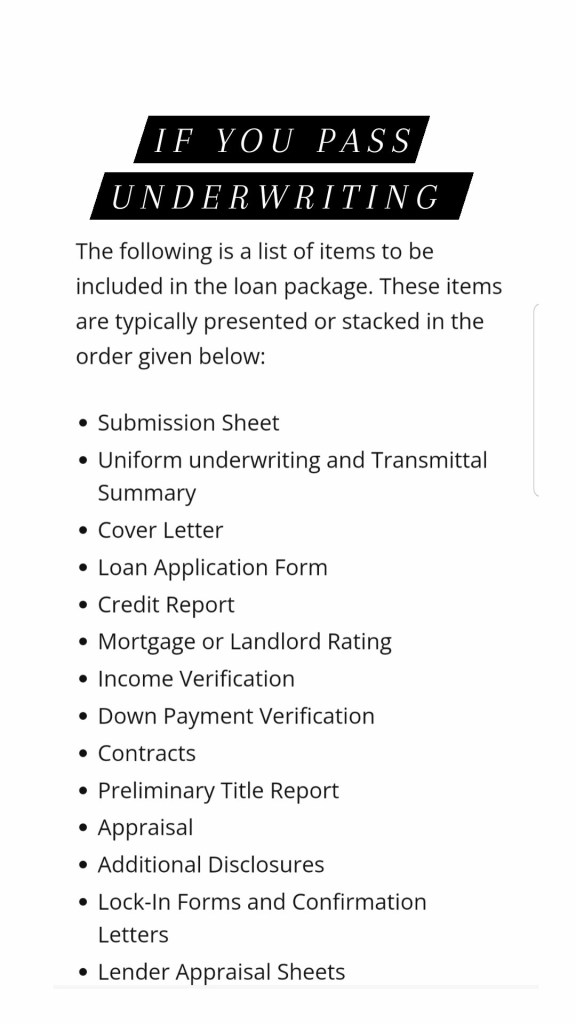
This is the actual approval process of your loan and when you’re actually going to be determining eligibility for the loan you applied for. This is a deep dive into your account history and all of your finances, line by line, and everything on your credit report. They’re doing an investigation basically into your employment status, your balances, your credit usage, your past history, and everything else.
A lot of these begin right away but basically coincide and are part of the bank decision making the loan or not. How does the home appraise, what’s in the title chain, and verify everything listed on your end and the rest about the property. If you get past all of the above and underwriting, you’re good to go usually.









 Jennifer Larson